

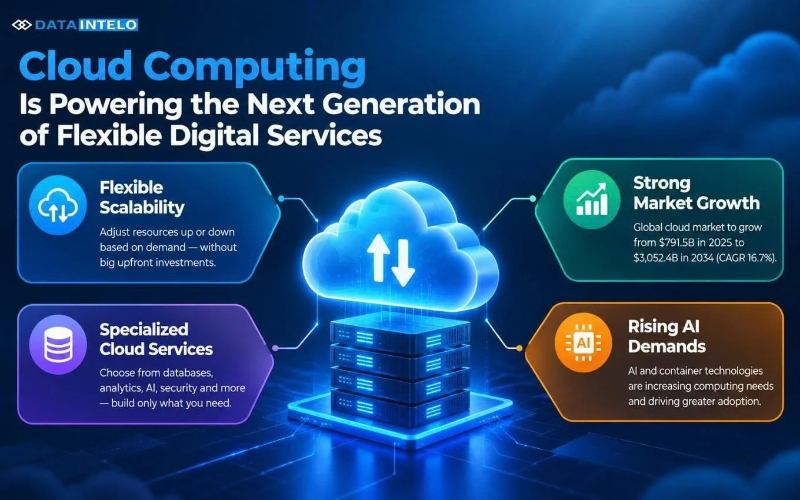
Cloud Computing Is Powering the Next Generation of Flexible Digital Services
Cloud computing has revolutionized how digital service processes work. Businesses no longer depend solely on physical servers and internal infrastructure. Instead, they can acquire required computing power, storage, database, software, and analytical tools through the use of cloud computing platforms.
As the volume of digital products increases, organizations need infrastructure capable of changing accordingly without special investments. Cloud computing provides solutions in this sphere, as resources can be changed according to the needs.
Moving Beyond Fixed Infrastructure
In traditional infrastructure, organizations would buy servers and networking equipment ahead of time, even before the demand arose. For example, a company expecting huge growth would have already procured enough capacity for future use, even if most of it was not being used for a significant period.
The cloud computing solution differs from that. Computing resources can be allocated based on the workload, and unrestricted capacity can be added in case of increased demand. This approach is tremendously useful for provision of digital services with seasonal traffic, product launches, unexpected upsurges of use, and unpredictable customer behavior.
The variation can be substantial. For example, a solution using 100 computing units in the standard mode and 300 at peak times does not have to keep 300 units all the time. Cloud-based infrastructure can ensure that capacity planning closely corresponds to real usage.
This does not eliminate infrastructure planning. Instead, it moves planning toward resource allocation, workload monitoring, performance management, and cost control.
Cloud Services Are Becoming More Specialized
There is no one concept of cloud computing in practice anymore. Providers started offering various options for data bases, analytics, applications, artificial intelligence, security and automation.
| Cloud Service Area | Common Use | Main Benefit |
| Infrastructure | Computing, storage, networking | Resources can be adjusted as needed |
| Platform | Databases and application development | Reduces infrastructure administration |
| Software | Business and productivity applications | Simplifies deployment and access |
| AI and analytics | Model processing and data analysis | Supports changing processing requirements |
This specialization allows development teams to select services according to the job instead of building every component themselves. A database-heavy application, for example, may use managed database services while another workload relies heavily on computing resources for data processing.
The result is a more modular technology environment in which different services can be combined according to application requirements.
The enormity of this transition can be gauged through the growth of the market. Dataintelo forecasts that the global cloud computing market is likely to grow from $791.5 billion in 2025 to $3,052.4 billion in 2034, bringing the CAGR to 16.7%. The growth indicates that cloud infrastructure is moving beyond just an option for existing hosting methods and fast becoming foundational for digital operations.
AI Is Increasing Computing Requirements
Artificial intelligence is adding another layer of complexity to cloud infrastructure. Training and operating AI models can require substantial computing resources, while inference workloads may fluctuate according to application usage.
Kubernetes has become an essential part of this picture. In 2025, its percentage of adoption in production reached 82%, compared to 66% in 2023, indicating that container orchestration technology finds ever wider application in the processes of technology project implementation.
Generative AI is playing a significant role in making infrastructure choices as well. Approximately 66% of companies that operate generative AI systems are making use of Kubernetes for every or part of inference jobs. Deployment practices differ, 47% of companies saying they deploy models at occasions and 7% stating they do it every day.
These figures illustrate why infrastructure must support more than steady application traffic. AI workloads can involve large processing requirements, frequent model updates, and different performance expectations depending on the application.
Containers Are Supporting Application Portability
Containers are also becoming a significant element of modern cloud setups as they incorporate applications along with their necessary components. This leads to added ease in moving the workload from one environment to the other ones either in development, testing or production.
The arrival of new containers has been steadily increasing. In 2023, in production containers utilization was 41%, whereas in 2025 and it jumped to 56%. Conversely, cloud-native readjustments reached the highest possible result of 98%.
Portability can be a contributing factor to development in this area. Container-based apps can be implemented on various infrastructure environments involving fewer changes compared to usually required for other types of applications.
Containers may assist developers who have to work with many integrity of application. Overall parts of application can be treated in a separate manner allowing more efficient updates, testing, and implementation process.
Key Developments in Modern Cloud Architecture
Nowadays, the cloud ecosystem relies heavily on technologies such as automation and containerization which improves the effectiveness of software engineering. Some of the notable advancements include:
- Kubernetes: By the year 2025, the expected share of the platform will be 82% whereas its current share is 63%.
- Cloud-native development: 98% adoption stems from the increasing application of distributed application architecture.
- Containerized applications: production applications using it have increased over the last two years from 41% to 56%.
- Generative AI: 66% of organizations participating in generative AI projects apply Kubernetes in some if not all inference tasks.
- CI/CD has gained acceptance in close to 60% of organizations and allows for faster releases.
- GitOps is adopted by around 77% of organizations, which combine approaches to infrastructure management and development.
The strong growth of these technologies suggests that cloud architecture is primarily software-driven in nature. It is no longer regarded as a physical basis to applications deployed; nowadays, infrastructure can be managed through code, automation, policies, and orchestration platforms.
Data Growth Is Transforming Cloud Infrastructure
Digital services create another challenge for infrastructure as the quantity of data produced and processed increases. Cloud infrastructures need to maintain storage and computing needs and data movement between applications, databases, users, and analytical systems.
An increase in energy consumption of data centers is consequent. According to research, data centers in the United States consumed energy amounting to about 176 TWh in 2022 in comparison to 58 TWh in 2014. It is further predicted that this consumption may increase to the level of 325 to 580 TWh in 2028.
This raise of numbers implies something beyond mere data-center capacity. Cooling systems, networking devices, backup systems, and power distribution means all create a demand for resources required to run.
Thus, cloud vendors and companies need to be very efficient in terms of their infrastructure planning because it plays a very important role.
Security Must Scale With Cloud Operations
The use of cloud services has implications for security. It speeds up the implementation of infrastructure, but it necessitates that security measures are implemented equally quickly.
Organizations face several issues in applying effective security measures. Approximately 36% cite security concerns as an impediment and 47% indicate that the changing culture or organizational issues is a problem. Yet another 36% mention the lack of training or skills.
These matters signal that cloud security is not purely technical in nature. There are various technological procedures necessary for cloud security to work effectively, such as identity management, access policy, configuration, monitoring, employee behavior, and incident response.
As the number of services and applications that the organization uses is growing, security policies need to be more consistent.
Hybrid Structures Allow for More Options
Not every organization is able or willing to move 100% into the public cloud. Some organizations continue to run their own private systems due to a combination of compliance regulations, previous investments, performance issues, and data handling regulations.
Hybrid architecture enables organizations to mix various environments. For example, a company can keep its confidential databases on its own servers while using public cloud for analytics or portal applications.
This strategy also enables companies to move to the public cloud progressively. Instead of simply tossing their existing systems out the window, they can transfer certain applications to the public cloud while still keeping the systems that can still be effective where they are.
The challenge is management. Multiple environments require consistent monitoring, identity controls, networking, governance, and cost oversight.
Automation Is Changing Cloud Management
As cloud environments become larger, manually managing every resource becomes increasingly difficult. Automation helps organizations handle repetitive infrastructure tasks while reducing the amount of manual intervention required.
CI/CD practices are adopted in around 60% of organizations and help improve the consistency of changes made in software testing and deployment procedures. GitOps is used in about 77% of companies and applies the same principles as in CI/CD to infrastructure management in the form of treating configuration as code and implementing version-controlled processes.
Automation can also be used to detect resources that are not being utilized, optimize capacities as needed, execute security policies and handle operational incidents.
The goal is not simply to make systems faster. It is to make infrastructure management more predictable and repeatable. For large digital services, that can reduce operational friction as the number of applications and environments grows.
The Next Phase of Digital Services
Cloud computing is evolving from the concept of just leasing computing resources. Today’s cloud platforms incorporate containers, orchestration, AI workflows, automation, managed services, analytics, and an array of infrastructure types.
The next phase will be centered around efficiency of those elements. Each organization should consider how to achieve a balance between performance and cost, speed of deployment and security, and the rising need for data and energy efficiency.
With the advancement of data-driven applications and AI, cloud computing will keep transforming the development and dissemination of software. It is insufficient to have just IT resources; there should also be effective, safe, and efficient usage of these resources.
This trend will probably remain relevant in the future, as organizations provide their clients with digital services that will handle evolving workloads, technologies, and complicated tasks.


Leave feedback about this
You must be logged in to post a comment.